You built the website. You’re getting visitors. But the enquiries? Crickets.
If that sounds familiar, you’re not alone. Most freelancers and agencies have the same problem — decent traffic, terrible conversion. The good news: you don’t need more visitors. You need your existing visitors to actually reach out.
This guide covers exactly how to do that — practical, no-fluff tactics that work for freelancers and small agencies in the US and UK.
1. Your Homepage Has 5 Seconds. Use Them.
When someone lands on your homepage, they’re asking one question: “Is this for me?” If they can’t answer that in five seconds, they leave.
Most freelancer and agency websites fail here because the headline is vague — something like “We build digital experiences” or “Creative solutions for modern brands.” That tells a visitor nothing.
Fix it with a clear value headline that names:
- Who you help
- What you do for them
- What result they get
Before: “Full-service digital agency based in London.”
After: “We help e-commerce brands in the UK double their conversion rate in 90 days.”
Specific beats clever every time.
2. One Clear CTA — Not Five
Look at your homepage right now. How many different buttons or links are competing for attention? “See our work.” “Read our blog.” “Follow us.” “Get a quote.” “Learn more.”
Every extra option reduces the chance a visitor takes any action. This is called decision paralysis, and it kills leads silently.
Pick one primary CTA and make it impossible to miss:
- Use a contrasting button colour
- Place it above the fold (no scrolling needed)
- Make it outcome-focused — “Get a Free Proposal” beats “Contact Us”
- Repeat it at the bottom of every key page
Everything else on the page should support that one action, not compete with it.
3. Add Social Proof Where It Actually Counts
Testimonials buried on a dedicated “/testimonials” page don’t convert. Nobody clicks there. Social proof works best when it appears right next to the moment of decision.
Here’s where to place it strategically:
- Homepage — directly below your headline or CTA button
- Services pages — after describing what you do, before the contact form
- Contact page — right next to the form itself
- Pricing page — next to the price, where hesitation peaks
The best testimonials mention a specific result, not just a vibe. “They redesigned our site and it looks great” is weak. “After their redesign, our enquiry rate went up 40% in the first month” is what closes deals.
4. Make Your Contact Form Stupid Simple
Every extra field in your contact form costs you leads. People are lazy and suspicious — the more you ask for upfront, the more they bail.
For most freelancers and agencies, you only need:
- Name
- A brief message or project type
That’s it. You can get budget, timeline, and everything else on the call. The goal of the form is one thing: get the conversation started.
Also check that your form actually works. It sounds obvious, but a surprising number of enquiry forms silently break after plugin updates or theme changes — and owners don’t find out for weeks. Test it yourself right now.
5. Your Services Page Is Probably Too Vague
Most agency services pages list what they do. The ones that convert well explain what the client gets.
Compare these two approaches:
Vague: “We offer brand strategy, web design, and digital marketing.”
Specific: “Our brand strategy package gives you a complete visual identity, messaging framework, and a 12-month content roadmap — so you can show up consistently and attract the right clients.”
Walk through each service and ask: “What does the client walk away with? What problem does this solve? Who is it for?” Answer those three questions on the page and your enquiry rate will improve.
6. Use a Lead Magnet to Capture Visitors Who Aren’t Ready Yet
Most visitors who land on your site aren’t ready to hire you today. That doesn’t mean they never will be — it means you need a way to stay in front of them.
A lead magnet is a free resource you offer in exchange for an email address. For freelancers and agencies, high-converting lead magnets include:
- A free website audit or checklist
- A short guide (“5 things your website needs before you run ads”)
- A free 20-minute strategy call
- A template relevant to your niche
Once someone’s on your list, you can nurture them over weeks or months until they’re ready to buy — without spending a penny on ads.
7. Fix Your Website’s SEO Health First
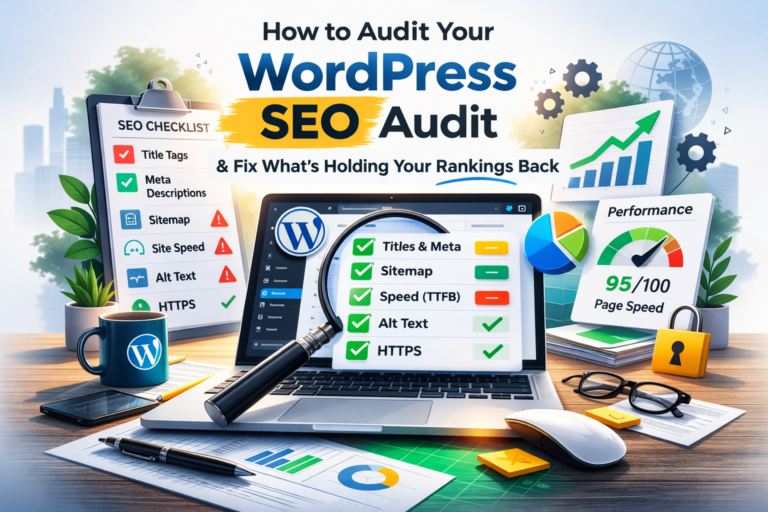
None of the above matters if your site has technical issues silently hurting your visibility — slow page speed, missing meta descriptions, broken links, or pages Google can’t crawl properly.
Before investing more time into conversion tactics, run a proper SEO audit to find what’s holding your site back. Tools like Vixion Health can scan your WordPress site across 18 different checks — from HTTPS security and sitemap status to content quality and heading structure — and show you exactly what to fix, in plain English.
A healthy site converts better because it loads faster, ranks higher, and gives visitors no technical reason to leave.
8. Speed Matters More Than You Think
A one-second delay in page load time can drop conversions by 7%. For a freelancer or small agency, that’s real money walking out the door.
Quick wins to improve site speed:
- Compress images before uploading (or use a plugin like Smush or ShortPixel)
- Use a caching plugin (WP Rocket or W3 Total Cache)
- Switch to a fast, lightweight theme
- Move to a better host if you’re on cheap shared hosting
Test your current speed at Google PageSpeed Insights — it’s free and shows you exactly what’s slowing you down.
9. Add Live Chat or a Chatbot
Sometimes visitors have a quick question before they commit to filling in a form. If there’s no easy way to ask it, they leave.
Adding a simple live chat widget — even one that’s offline most of the time and collects a name and email — can recover a meaningful percentage of those almost-leads. Tools like Tidio, Crisp, or Intercom all have free tiers suitable for freelancers and small agencies.
If you’re a solo freelancer and can’t monitor live chat, set up a chatbot with a few pre-set answers to common questions (“What’s your availability?” “Do you work with e-commerce brands?”) and a prompt to book a call.
10. Follow Up With Every Enquiry — Fast
This one isn’t about your website, but it determines whether website leads actually become clients.
Studies consistently show that responding to an enquiry within 5 minutes makes you 21x more likely to qualify that lead than responding an hour later. Most freelancers and agencies take days.
Set up an instant auto-reply when someone submits your contact form — even just a “Thanks, I’ve got your message and I’ll be in touch within 24 hours” is enough to buy time while signalling that you’re professional and responsive.
Quick-Win Checklist
Before you close this tab, run through these:
- ☐ Does your homepage headline say clearly who you help and what they get?
- ☐ Is there one obvious CTA above the fold?
- ☐ Do you have a testimonial with a specific result near your CTA?
- ☐ Does your contact form have 3 fields or fewer?
- ☐ Have you tested your contact form recently?
- ☐ Do your services pages describe outcomes, not just deliverables?
- ☐ Is your site loading in under 3 seconds?
- ☐ Do you have a lead magnet for visitors not ready to hire yet?
- ☐ Have you run an SEO health check in the last month?
- ☐ Do enquiries get an auto-reply within minutes?
Tick off even half of these and you’ll see a noticeable difference in how many visitors turn into actual conversations.
Final Thought
Getting more leads from your website isn’t about a redesign or spending more on ads. It’s about removing the friction that’s silently stopping willing visitors from reaching out.
Start with one thing on this list today. Pick the easiest one. Ship it. Then move to the next. Small, consistent improvements compound — and six months from now, your website will be doing a much better job of selling for you while you sleep.
Want to know what’s holding your site back right now? Run a free Vixion Health audit — it checks your site across 18 factors and shows you exactly what to fix first.